Duolingo for Rehab.

The only gamified AI rehab for movement and speech. At home.

Backed by 1,000+ user surveys and scientific research.

Featured on
Clinical & NGO Partner
SEN With You and more clinical partners
Consultant Therapists
Norwich City FC (EFL) North Walsham RFC
Backed by US · UK · Hong Kong · Worldwide

Research-backed

Backed by 1,000+ user surveys

75%

identify lack of tracking as the main barrier to at-home rehab.

80%

find our rehab guidelines intuitive and easy to follow.

85%

report higher engagement with our gamified approach.

Built by engineers from Berkeley, NTU and EPFL, together with physiotherapists and speech therapists.

Meet our team at coglixlabs.com →

UC Berkeley NTU EPFL

Move. Speak. Recover.

Technology disappears. Recovery feels human. Therapy feels like play.

Who can benefit

Movement

Stroke · Brain Injury · Parkinson's · Multiple Sclerosis · Spinal Cord Injury · Sports Injuries

Speech

Aphasia · Dysarthria · Apraxia of Speech · Stuttering

Special Educational Needs

ADHD · Autism Spectrum · Learning Difficulties · Developmental Coordination

29 Guided Exercises

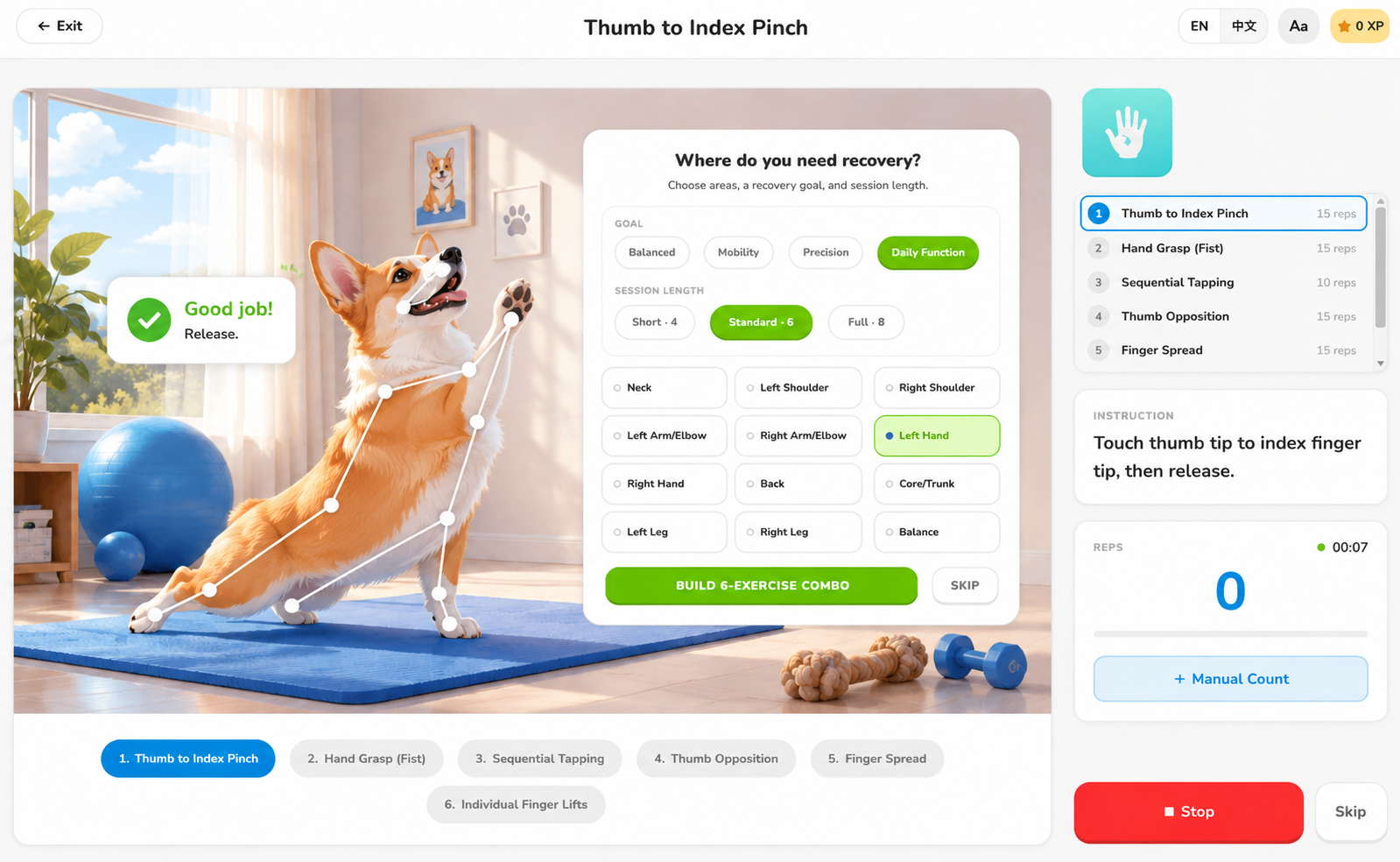
Computer vision guides every rep. From gross motor recovery to fine finger control.

Invisible technology. Visible recovery.

Computer Vision

See every movement.

Your webcam tracks hand and body movements in real time — no wearables needed. Joint angles, range of motion, and rep counting guide every exercise automatically.

HIPAA Compliant ISO 27001 Aligned GDPR, PDPO, PIPEDA & APP Compliant

All PHI is end-to-end encrypted (E2EE). View compliance details →

What therapists and patients are saying

“The games are intuitive and goal-oriented — patients stay engaged without any hand-holding.”

Norwich City FC

Physiotherapist

Norwich City Football Club (EFL)

“The tutorials and objectives are crystal clear, and the platform covers a wide range of exercises — a truly comprehensive rehab tool.”

North Walsham RFC

Physiotherapist

North Walsham Rugby Club

“There hasn't been a convenient tool for conducting mirror therapy with my patients — I'm glad to have found one at Coglix Labs. RehabDojo and SpeechDojo are genuinely engaging, and I'd recommend them to fellow therapists without hesitation.”

Physiotherapist

“Stroke patients in Hong Kong are predominantly elderly, so usability barriers are extremely common. Other platforms exist, but none feel this all-in-one. The clean interface with bilingual Chinese and English support makes it genuinely user-friendly.”

The Hong Kong Polytechnic University

Physiotherapy Student

The Hong Kong Polytechnic University

“The structured exercises integrate seamlessly into my patients' daily home practice.”

The University of Hong Kong

Speech Therapist

Hong Kong Registered

“So convenient to use at home — the instructions are clear, and the experience is far more engaging than traditional rehab exercises.”

M

Patient Ms. M

Stroke Recovery Patient

Common questions

Can I do physical therapy at home with Sync?
Yes. Sync runs in any browser using your iPad or computer's built-in webcam — no sensors or downloads needed. A computer vision model tracks your movements in real time and gives instant feedback on form and rep count, the same correction quality you'd receive in a clinic session.
What makes Sync different from home exercise handouts?
Paper handouts have no feedback loop — you do the reps but nothing confirms correct form. Sync counts every repetition, scores movement accuracy, and adjusts difficulty in real time. Sessions are structured as games rather than checklists, which research links to significantly higher long-term adherence compared to passive handout programs.
How long should a stroke patient exercise at home each day?
Most stroke rehab guidelines recommend 45–60 minutes of task-specific practice per day in the first months after stroke. Sync sessions are structured in 15–30 minute blocks to fit around fatigue. Therapists prescribe the frequency and module type that match each patient's recovery stage.
What conditions does Sync support?
Sync supports rehabilitation for stroke (cerebrovascular accident), traumatic brain injury (TBI), Parkinson's disease, multiple sclerosis, aphasia, dysarthria, apraxia of speech, and upper-limb sports injuries. The movement tracking module applies to any condition requiring structured repetitive motor practice with real-time feedback.

Recovery starts here.

See how Sync makes neurorehabilitation feel intuitive and human.

Request Demo